
Edited by Paola Nola and Francesca Virelli
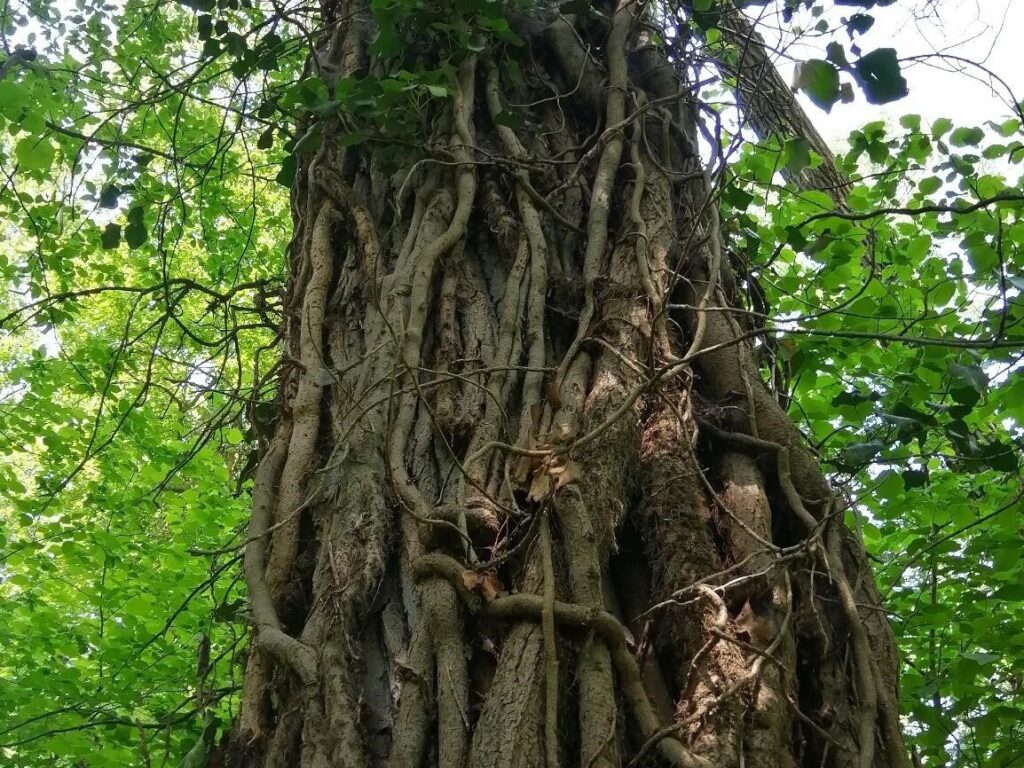
Ivy is by far the most common vine in lowland oak forests, where it often behaves invasively. The creeping form can demonstrate its invasive nature by covering the undergrowth, creating a homogeneous layer and making it more difficult for other species to establish themselves, particularly the regeneration of characteristic forest species. The climbing form can develop a woody stem, initially slender and sinuous, but which over time can become a real trunk several centimetres in diameter, from which a dense canopy develops that intertwines with that of the tree supporting it. Its ability to climb is linked to the stem forming numerous adventitious roots, resembling a dense down, which allow it to cling to the plant’s bark without, however, penetrating the stem or depriving it of any resources. The factors determining the transition from a creeping to a climbing form are not yet fully understood, but it seems that light plays an important role.
A study conducted in the Bosco Siro Negri Nature Reserve (Castagneri et al 2013) quantified the presence of the species on 374 trees across four sample areas (covering a total of 1 hectare), seeking any links between its distribution and the characteristics of the trees on which it grows. The results showed an average density of 657 individuals with a diameter > 0.5 cm, of which approximately one-third had a diameter > 2.5 cm. The largest individuals reach 14 cm in diameter.
52% of the surveyed trees have at least one ivy plant, but in some cases numerous separate plants are climbing the same tree, with an average of more than three plants per tree. The average growth in diameter is just over 1 cm per year and is linked to the space available on the host plant’s trunk; in other words, it depends on the number of ivy plants climbing the same trunk and their size.
The ideal host is represented by large trees, with few competing trees nearby. In particular, the oak, which within the reserve is the largest species with a broad canopy under which other trees rarely grow, appears to be the preferred host. Conversely, trees without climbing ivy are predominantly small and are found in areas of high density.
Ivy has traditionally been viewed as having a negative effect on the growth of the host plant, based on the mistaken belief that it is a parasitic species; indeed, the practice of cutting ivy at the base of the tree, leaving the remaining aerial parts to wither, is still widespread today. Although it is now clear that ivy does not directly deprive its host of nutrients, in reality too little is still known about its role within the forest ecosystem, and its abundance in some woods showing signs of decline gives rise to debate and conflicting views regarding its management.
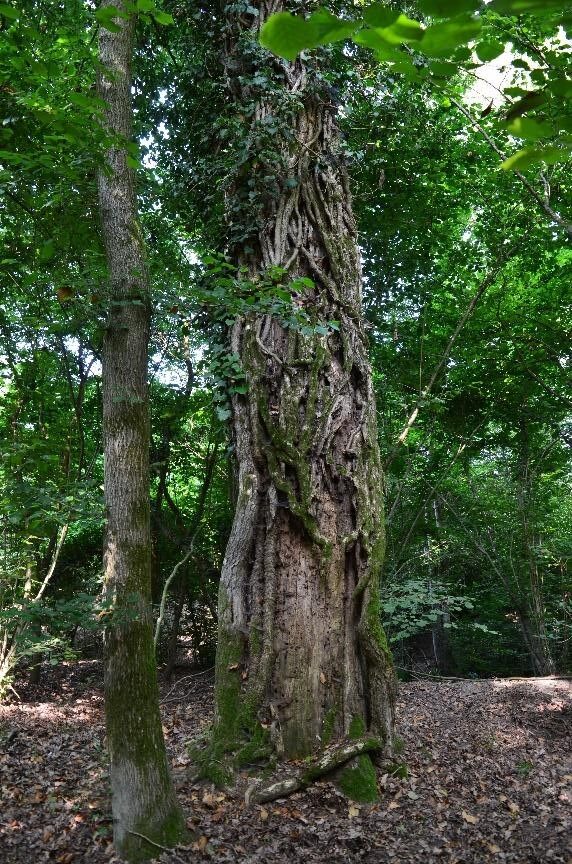
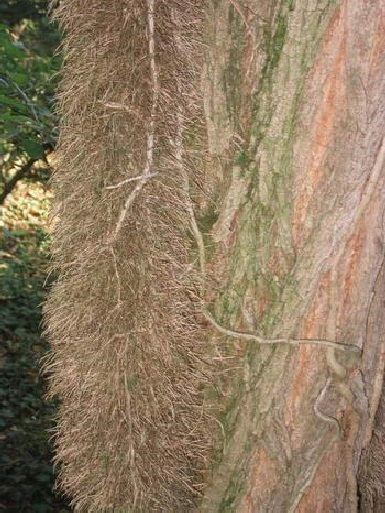
Undoubtedly, large ivy plants that reach the canopy compete with the tree population, both at ground level—where the roots of different plants must share water and nutrients—and at canopy level, where the struggle for available light takes place. On the other hand, the search for light is the objective. However, it is often found that an abundance of light is one of the factors that induces the climbing habit of the vine, as this is more common in areas where the forest canopy is open, for example near fallen large trees that allow more light to reach the ground, but also near dying trees with a particularly reduced canopy that is almost completely overgrown by the ivy’s own foliage. At present, therefore, it is not possible to determine with certainty whether the abundance of ivy found within a woodland constitutes a stress factor for the tree population—whose foliage, covered in ivy, significantly reduces photosynthetic activity and, consequently, growth—or whether it represents a factor of weakness that triggers a process of decline already underway. In the latter case, the low leaf density of the declining plants, which allows more light to reach the ground, could be the factor that encourages the transition from a creeping to a climbing form and the rapid growth of the latter.
See also: Daniele Castagneri • Matteo Garbarino • Paola Nola (2013) Host preference and growth patterns of ivy (Hedera helix L.) in a temperate alluvial forest – – Plant Ecology 214, 1–9 https://doi.org/10.1007/s11258-012-0130-5